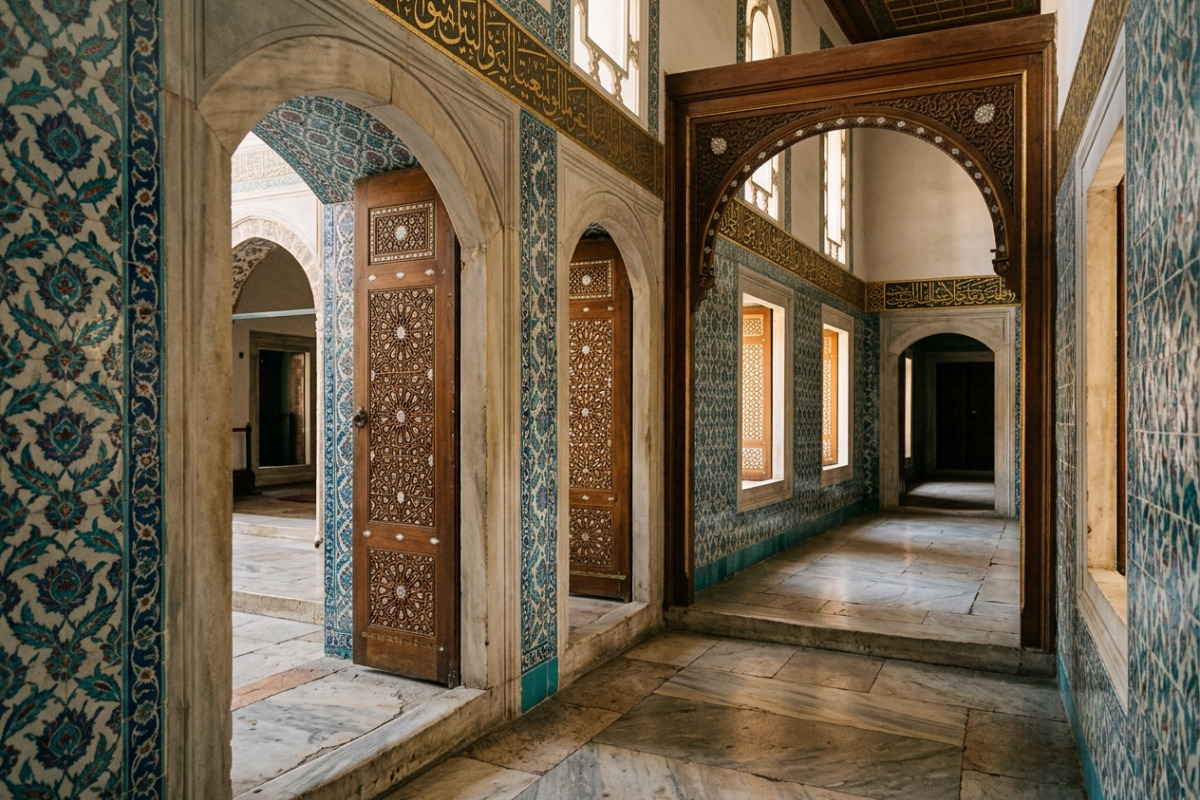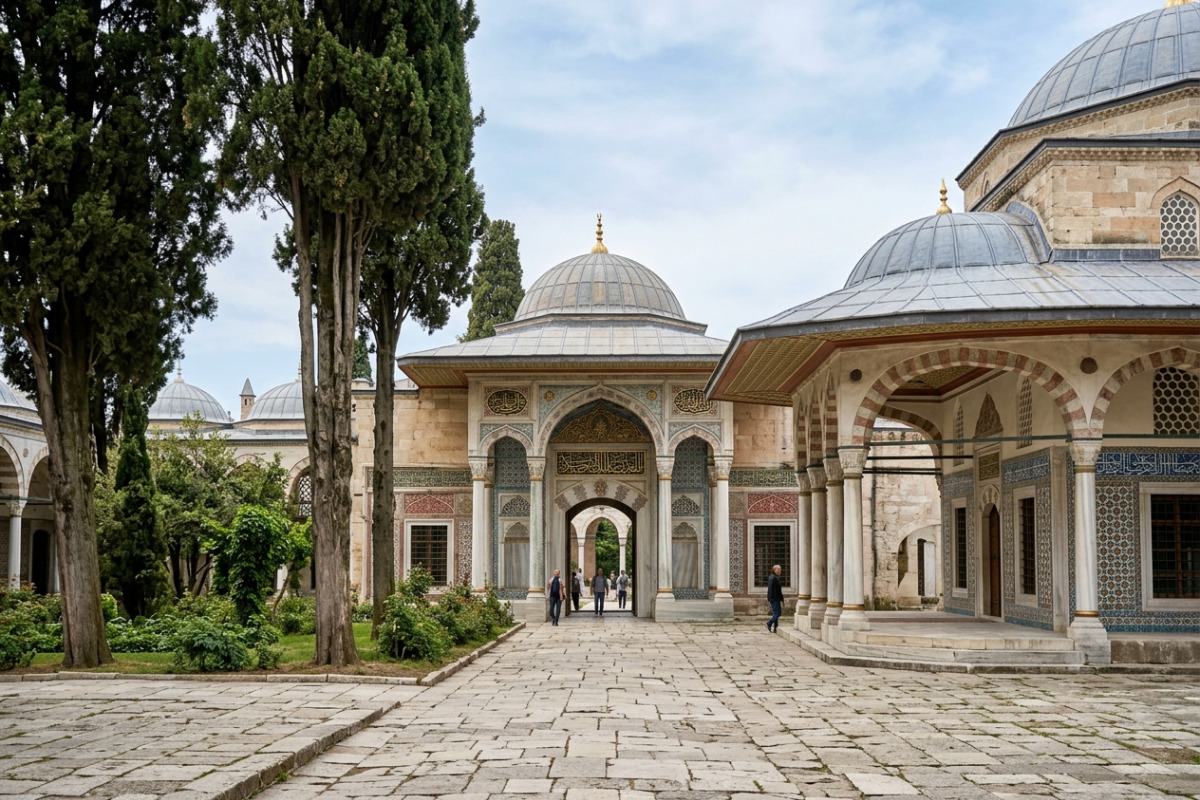
When you step through the imposing gates of Topkapi Palace, the sheer scale of the architecture commands your immediate attention, but it is the details that steal your heart. As you wander from the sprawling courtyards into the intimate chambers of the Harem, the atmosphere shifts dramatically. Suddenly, you are enveloped in a kaleidoscope of blues, turquoises, and vivid reds that seem to glow with an inner light. This is not merely decoration; it is a sophisticated language of power, faith, and artistic mastery written in ceramic. For the traveler standing here in January 2026, these tiles are not just historical artifacts; they are vibrant survivors of a golden age, offering a glimpse into the soul of the Ottoman Empire.
The visual impact of Topkapi is largely defined by these ceramic masterpieces, primarily produced in the legendary kilns of Iznik. While visitors often admire the overall aesthetic, few pause to understand the incredible scientific and artistic breakthroughs required to create them. The walls of the palace do not just separate rooms; they tell stories of a civilization that valued beauty as a reflection of the divine. To truly appreciate Topkapi, one must look closer at the glaze, the patterns, and the silent geometry that has withstood centuries of earthquakes, fires, and changing empires. [Buraya, genel bir Topkapı Sarayı veya İznik çinilerini gösteren bir görsel eklenebilir.]
The Iznik Miracle: A Chemical Revolution
The tiles adorning the walls of Topkapi Palace are distinct from standard ceramics found elsewhere in the world, primarily due to their unique chemical composition. Unlike traditional pottery made from simple clay, Iznik tiles are technically a form of 'fritware.' The Ottoman artisans developed a formula that consisted of up to 85% quartz, a mineral that is notoriously difficult to work with but yields exceptional results. This high quartz content is the secret behind the tiles' extraordinary durability and their glass-like ability to reflect light, making the walls appear to shimmer as the sun moves across the Istanbul sky.
Working with quartz required a mastery of thermal dynamics that was ahead of its time. The paste had to be fired at precise temperatures to prevent the object from shattering while ensuring the glaze bonded perfectly to the body. This process resulted in a white, hard base that mimicked the highly prized Chinese porcelain of the Ming Dynasty, which the Ottoman Sultans admired greatly. However, the Ottoman potters did not merely copy; they innovated, creating a distinct style that married the purity of the white background with a vibrant, localized color palette.
The Quest for the Perfect Red
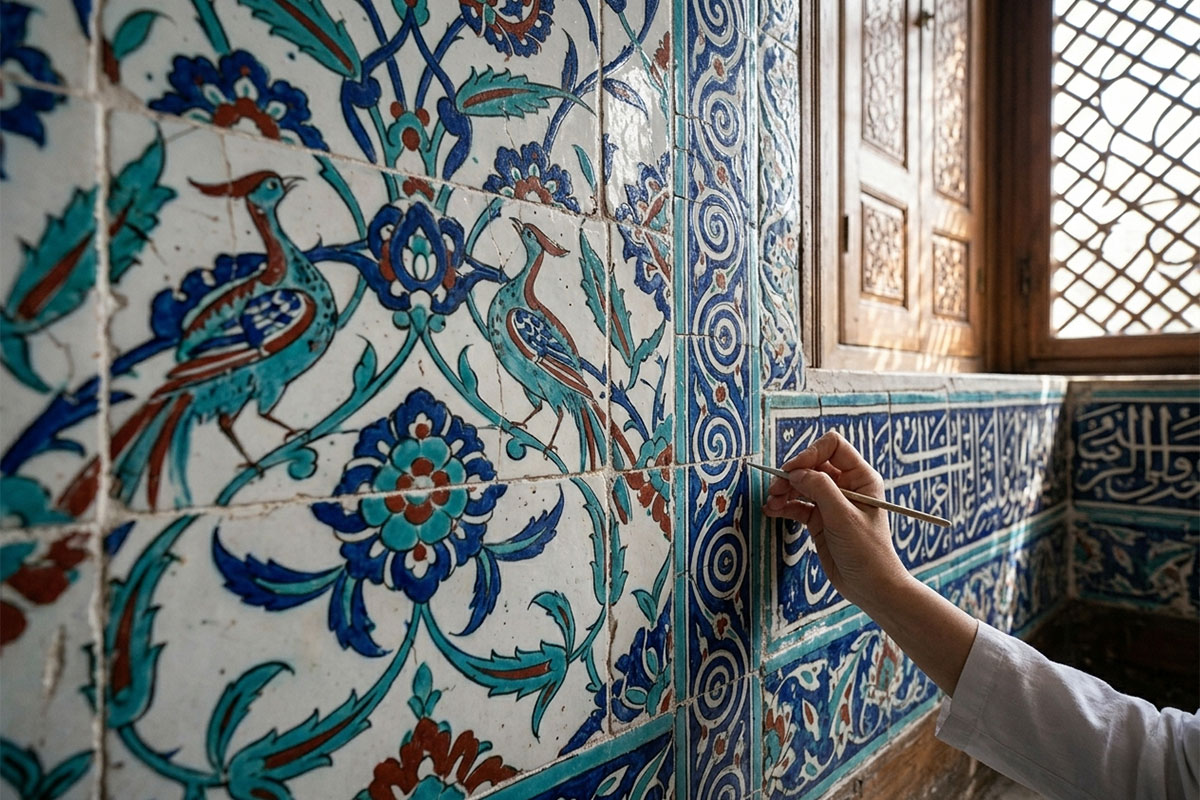
In the early years of the palace's decoration, the color scheme was dominated by cobalt blue and white, followed by the introduction of turquoise and manganese purple. However, the 16th century marked the zenith of this art form with the discovery of the famous 'coral red' or 'bolu red.' This vivid, slightly embossed red color became the signature of the classical Iznik style. Achieving this specific hue was a technical nightmare for potters because the iron-rich pigment often burned out or turned brown under high heat. The fact that we can still see this relief red popping from the walls of the Harem today is a testament to a chemical formula that was perfected in the 1550s and, mysteriously, lost by the 17th century. [Buraya, özellikle 'bolu red' rengini gösteren bir İznik çinisi görseli eklenebilir.]
Decoding the Floral Language
The intricate patterns swirling across the palace walls are never random; they are a sophisticated botanical garden frozen in time. The Ottoman artistic tradition generally avoided figurative representation of humans or animals in religious and public spaces, leading to the development of a highly complex floral iconography. Each flower chosen by the court artists carried a specific meaning, turning the walls into legible texts for those who knew how to read them.
Understanding these symbols enriches the visitor's experience, transforming a beautiful wall into a meaningful narrative. The interplay of these motifs created a vision of a heavenly garden, a paradise on earth, which was a central concept in Islamic architecture. Below is a breakdown of the most common motifs you will encounter during your exploration:
| Motif | Symbolic Meaning | Cultural Significance |
| The Tulip (Lale) | Unity of God / The Divine | In Ottoman script, the letters for 'Lale' are the same as 'Allah.' It represents spiritual perfection. |
| The Rose | Prophet Muhammad | Symbolizes divine love and the beauty of the Prophet. |
| The Cypress Tree | Eternity and Strength | Often depicted swaying, representing the soul's longing for God and resilience against the wind. |
| The Carnation | Renewal and Spring | Stylized with fan-like petals, representing the cycle of life and nature's rebirth. |
| Chintamani | Power and Strength | Three spots and wavy lines, originally a Buddhist symbol adopted to represent the Sultan's might. |
Architectural Masterpieces: Where to Look
While tiles are present throughout the complex, certain rooms within Topkapi Palace display the pinnacle of this craftsmanship. The Chamber of the Holy Relics and the Circumcision Room exhibit some of the finest examples of blue-and-white tiles that date back to the early 16th century. These panels are massive, single-piece creations that would be incredibly difficult to fire today without warping. The deep indigo blues used here draw the eye inward, creating a contemplative atmosphere suitable for the spiritual significance of the space.
However, the true explosion of color is found within the Harem, specifically in the Apartments of the Queen Mother (Valide Sultan) and the Twin Kiosks. Here, the walls are covered from floor to ceiling in high-quality tiles featuring the full polychrome palette: emerald green, turquoise, cobalt blue, and the relief red. The way these tiles are arranged is crucial; they are often framed by calligraphy bands quoting verses from the Quran or poetry, integrating the written word with visual beauty. The acoustics and light reflection in these rooms are modified by the glazed surfaces, creating a sensory experience that was exclusive to the Sultan's inner circle. [Buraya, Harem'deki Apartments of the Queen Mother veya Twin Kiosks'tan bir görsel eklenebilir.]
The Painstaking Process of Creation
The creation of a single panel of tiles for Topkapi was a labor-intensive process that could take months involving multiple guilds of craftsmen. It was not a solitary art but a collective industrial effort that required strict quality control from the Ottoman court. If a tile was flawed, it was discarded; only the perfect pieces made it to Istanbul. The dedication to perfection is evident in the seamless continuity of patterns that flow across curved surfaces and corners.
To understand the value of what you are seeing, consider the stages involved in producing just one of these ceramic squares:
- Preparation of the Paste: Quartz was ground down and mixed with fine clay and frit (ground glass) to create a dough-like consistency.
- Drying and Shaping: The paste was shaped into molds and left to dry slowly to prevent cracking, a process that could take weeks depending on the humidity.
- The First Firing: The raw tiles were fired to create a 'biscuit,' a semi-hard canvas ready for painting.
- Pattern Transfer: Artists used charcoal dust pounced through pinpricked paper stencils to transfer complex geometric designs onto the tile.
- Painting and Glazing: Mineral-based pigments were applied with brushes made from donkey hair, followed by a thick layer of lead-alkaline glaze.
- The Final Fire: The most dangerous step, where the kiln was heated to over 900°C. A few degrees too hot, and the colors would run; too cool, and the glaze would not crystalize.
Preserving a Fragile Legacy
As we admire these works in 2026, it is vital to acknowledge the fragility of this heritage. The art of true Iznik ceramics declined sharply in the 17th century due to economic struggles and the loss of knowledge regarding the specific chemical formulas. For centuries, the 'secret' of the coral red and the high-quartz body was lost to history, making the tiles at Topkapi irreplaceable. Modern restoration efforts have been meticulous, using non-invasive cleaning techniques to remove centuries of soot from oil lamps and candle smoke without damaging the delicate glaze.
Today's visitors are witnessing the results of extensive conservation projects that have restored the brilliance of the Harem's walls. When you walk through these corridors, you are not just looking at pretty walls; you are witnessing the survivor of a lost technology. The tiles serve as a reminder of a time when art, science, and faith were inextricably linked, creating a legacy that continues to awe the world. So, the next time you find yourself in the shadow of the Twin Kiosks, lean in close. Look for the slightly raised texture of the red tulips, feel the cool radiation of the quartz, and appreciate the silent, enduring craftsmanship of the Ottoman masters.